BESS: Key technology in green transition – but not without challenges
With the increasing share of renewable energy in the electricity grid, the need for flexible storage solutions is growing. Battery Energy Storage Systems (BESS) are one of the solutions – but the technology places demand on design, installation and operation.
Elpress solutions chosen for precision and durability
Eltel has completed a number of BESS projects in Denmark and has chosen Elpress as its supplier of cable lugs (AKK series) and crimping tools (PVX1300). The choice was made on the basis of documented quality and high contact resistance reliability.
“We focus on long-term operational reliability and low energy loss. Elpress’ mandrel crimping system for aluminum has proven to provide the most stable connection between conductor and terminal,” says Michael Mezöfi.

Flexibility in an unstable energy system
Solar and wind energy are produced when the weather permits – not necessarily when demand is highest.
This has long been a challenge for the green transition. Large amounts of green electricity are wasted, while fossil fuel power plants have to fill the gaps.
This is where BESS plants come into the picture.
By storing excess electricity and releasing it during peak periods, BESS increases security of supply, utilises green electricity and contributes to lower CO₂ emissions.
The technology can also even out electricity prices and reduce the need for grid reinforcement from fossil fuels – provided that the solution is correctly dimensioned and integrated.
Technical structure – from solar cell to power grid
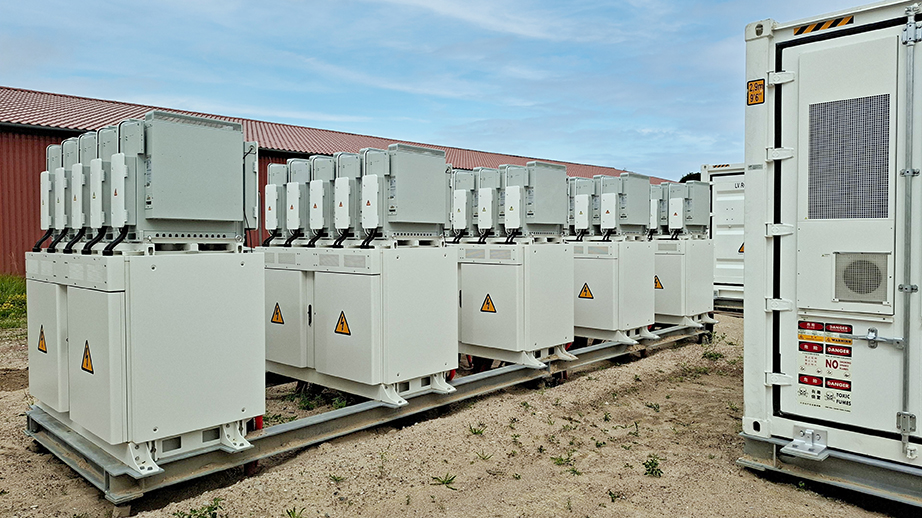
A typical BESS system consists of battery modules installed in a 20-foot container, connected to inverters and transformers. The system is often connected to a solar cell system that produces direct current (DC). This current is stored directly in the batteries and converted as needed into alternating current (AC), which is fed into the power grid via an inverter and transformer. Proper control of this conversion is essential for an efficient and stable power grid.
Not only in Denmark – but throughout Europe
The market for BESS is experiencing explosive growth. According to the International Energy Agency (IEA), global storage capacity is expected to quadruple by 2030.
In Denmark, we are seeing growing interest from operators with large buildings, warehouses, production facilities, agricultural buildings, and logistics centers, where the combination of solar cells and BESS systems is both technically and economically attractive for businesses and consumers, and not least for the environment.